
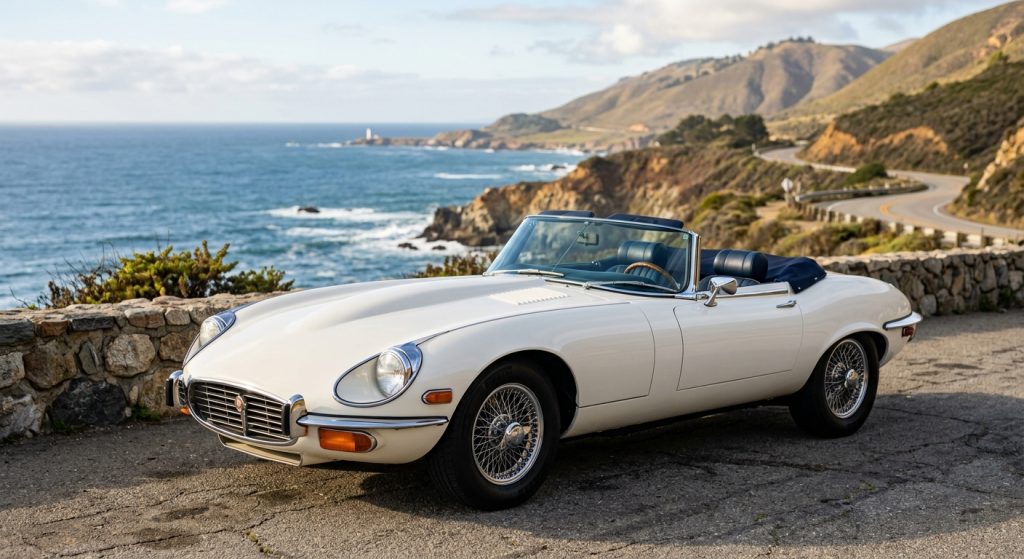
When the Jaguar E-Type (sold in North America as the XK-E) debuted at the Geneva Motor Show on March 15, 1961, it reshaped the automotive landscape overnight. Designed by aerodynamicist Malcolm Sayer using principles honed on Jaguar’s Le Mans-winning D-Type, its long bonnet, sweeping curves, and faired-in headlights famously prompted Enzo Ferrari to call it “the most beautiful car ever made.”
Beyond its striking looks, the E-Type offered supercar performance—a claimed 150 mph top speed—at a fraction of the price of contemporary Italian or British rivals.
Production Years and Generations
The E-Type was manufactured continuously from 1961 through 1974 across three distinct generations.

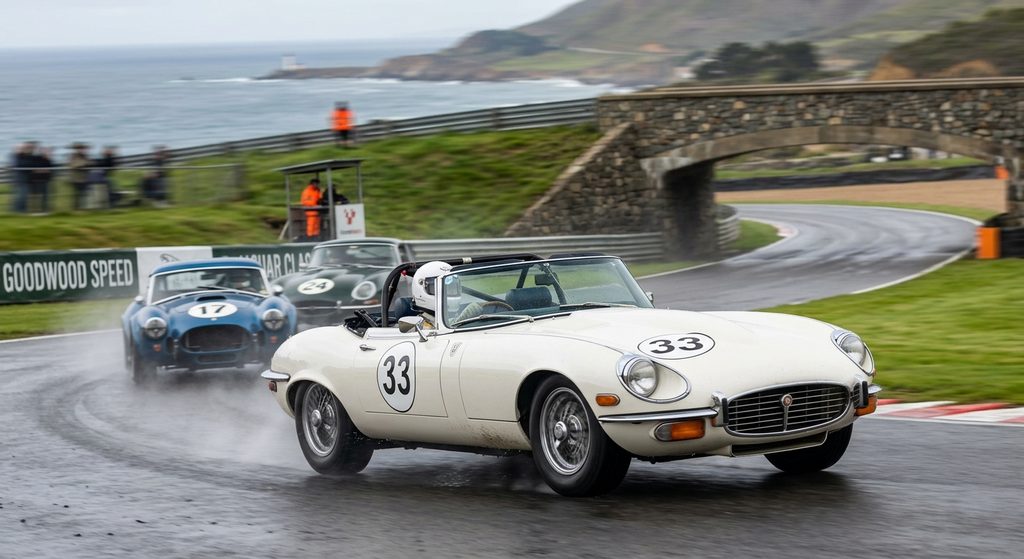
- Series 1 (1961–1968): The purest realisation of Sayer’s design, featuring glass-covered headlights, smooth body lines, and toggle switches inside. Early cars (1961–1964) utilised a 3.8-litre engine and a non-synchromesh first gear “Moss” transmission. In late 1964, Jaguar upgraded to a 4.2-litre engine and a fully synchromesh gearbox. A 2+2 coupe with an extended wheelbase arrived in 1966.
- Series 1.5 (1967–1968): A transitional, unofficial designation for cars modified to meet emerging US safety and emissions standards. Distinctive features included exposed headlights (no glass covers) and revised cabin switches.
- Series 2 (1968–1971): Fully compliant with US regulations, Series 2 models introduced open headlights, a larger front grille, wrap-around rear bumpers, twin electric cooling fans, and improved interior ergonomics.
- Series 3 (1971–1974): The final evolution saw the E-Type mature into a grand tourer. Powered by an all-new 5.3-litre V12, Series 3 cars featured a broader front grille, flared wheel arches, uprated brakes, and standard power steering. The short-wheelbase coupe was retired, leaving only the 2+2 coupe and the long-wheelbase roadster.
Technical Specifications & Performance Data
| Specification | Series 1 (3.8L) | Series 1 & 2 (4.2L) | Series 3 (5.3L V12) |
| Years Built | 1961–1964 | 1964–1971 | 1971–1974 |
| Engine Type | 3.8L Inline-6 (XK) | 4.2L Inline-6 (XK) | 5.3L V12 |
| Displacement | 3,781 cc | 4,235 cc | 5,343 cc |
| Horsepower | ~265 bhp @ 5,500 rpm | ~265 bhp @ 5,400 rpm | ~272 bhp @ 5,850 rpm |
| Torque | ~260 lb-ft @ 4,000 rpm | ~283 lb-ft @ 4,000 rpm | ~304 lb-ft @ 3,600 rpm |
| Transmission | 4-speed manual | 4-speed manual / 3-speed auto (2+2) | 4-speed manual / 3-speed auto |
| 0–60 mph Time | ~6.9 seconds | ~6.5 seconds | ~6.4 seconds |
| Top Speed | ~150 mph (241 km/h) | ~150 mph (241 km/h) | ~145 mph (233 km/h) |
| Curb Weight | ~2,900 lbs (1,315 kg) | ~3,020 lbs (1,370 kg) | ~3,360 lbs (1,525 kg) |
Engineering Innovations
The E-Type’s legendary performance was built on three foundational technologies advanced for their time:
- Monocoque Construction: Unlike the heavy ladder-frame chassis common in 1961, the E-Type used a lightweight central monocoque tub attached to a tubular steel front subframe carrying the engine and front suspension.
- Independent Rear Suspension (IRS): Designed by Bob Knight, Jaguar’s IRS used double wishbones, twin coil springs, and inboard disc brakes. This system delivered unmatched road-holding and ride quality, remaining a Jaguar hallmark for decades.
- Four-Wheel Disc Brakes: Standard servo-assisted disc brakes on all four wheels provided stopping power far superior to the drum setups found on contemporary competitors.
Legacy
Over its 14-year production life, more than 70,000 E-Types were produced. Today, it remains a symbol of 1960s British design, held in the permanent collection at the Museum of Modern Art (MoMA) in New York as a classic piece of industrial design art.